Control, management and, consequently, regulation of equipment are increasingly being entrusted to mechatronic systems capable of operating automatically and independently of the operator. These systems are so widespread that they are found in the vast majority of equipment types available on the market.
On some equipment, electronic systems assist the operator by providing real-time information on the progress of the operation; on others, they make a more significant contribution in terms of effectiveness and efficiency by relieving the operator of certain tasks through the use of mechatronic systems that regulate specific machine components. Still others, feature complex systems that fully control the equipment’s operation, leaving the operator with only steering and general monitoring tasks. Finally, robots, which are fully autonomous even in terms of guidance; however, to achieve this, they must be equipped with complex additional systems capable of ensuring the operation is carried out in complete safety.
Staying on the subject of equipment, it can be said that the complexity of these electronic and mechanical systems increases as the complexity of the interaction between the machine and the growing environment increases. Indeed, this interaction can be as simple as measuring the height above ground of a particular piece of equipment, or extremely complex when the aim is to identify the crop and perhaps even assess its physiological condition.
Sometimes the machine is equipped with automation systems that do not interact with the environment outside the machine, except incidentally, but only with the internal environment. Generally, these are machines that distribute some kind of product (seed, seedling, fertiliser, plant protection product, etc.), and such systems allow the operator to check whether the operation is proceeding in accordance with the parameters set by the operator and, if necessary, indicate how to correct them.
In other cases, systems have been developed that analyse the product once it has been loaded onto the machine, for example to carry out automatic sorting.
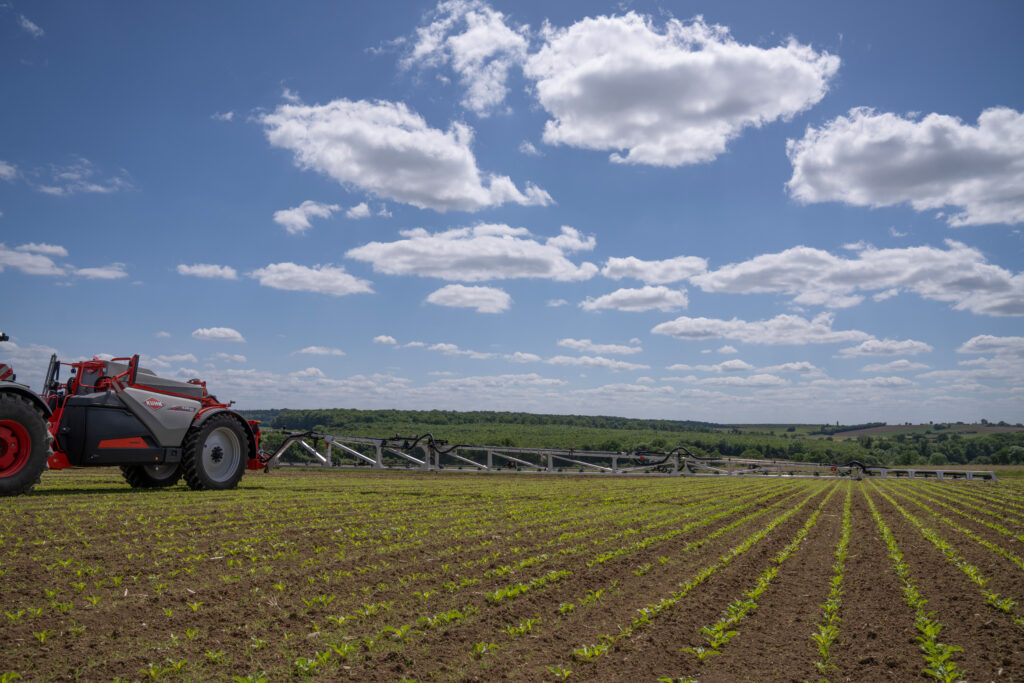
The Karan sprayer is equipped with an inertial sensor that monitors the boom’s position in real time, and ultrasonic sensors that measure the distance between the boom and the ground. The system’s high responsiveness and an innovative shock-absorbing parallelogram mechanism enable operation at very high forward speeds (Kuhn)
Interactions
During interactions, equipment needs to detect one or more pieces of information, process them, classify them, select the appropriate operational strategy and, finally, generate a command to be sent to the actuator. This is generally a device driven by a hydraulic pump, a pneumatic system or, increasingly nowadays, an electric motor. This device may be mechanical and fitted with a tool that interacts directly with the soil or the crop, or it may be a diffuser, such as a nozzle, in which case the interaction between the machine and the crop is indirect.
Any mechatronic system operating on agricultural machinery consists of one or more sensors that detect specific parameters and transmit them in digital or analogue form to a programmable logic controller (PLC). This is an industrial computer equipped with its own CPU, which is more powerful the greater the volume of information to be processed and the more complex the processing software; it is, of course, equipped with its own memory and input and output modules. In its simplest form, the PLC cyclically executes a programme that reads the input data, processes it and updates the output. This is generally connected to an actuator that executes the received command by adjusting the position or action of the tool. In more complex cases, programmable automation controllers (PACs) are used; compared to PLCs, these offer superior processing and control capabilities and are characterised by a modular, expandable architecture designed for connectivity.
The parameters recorded by this equipment vary; however, the most widely used automated systems generally record certain categories of information in varying degrees of detail. It is worth taking a closer look at them.
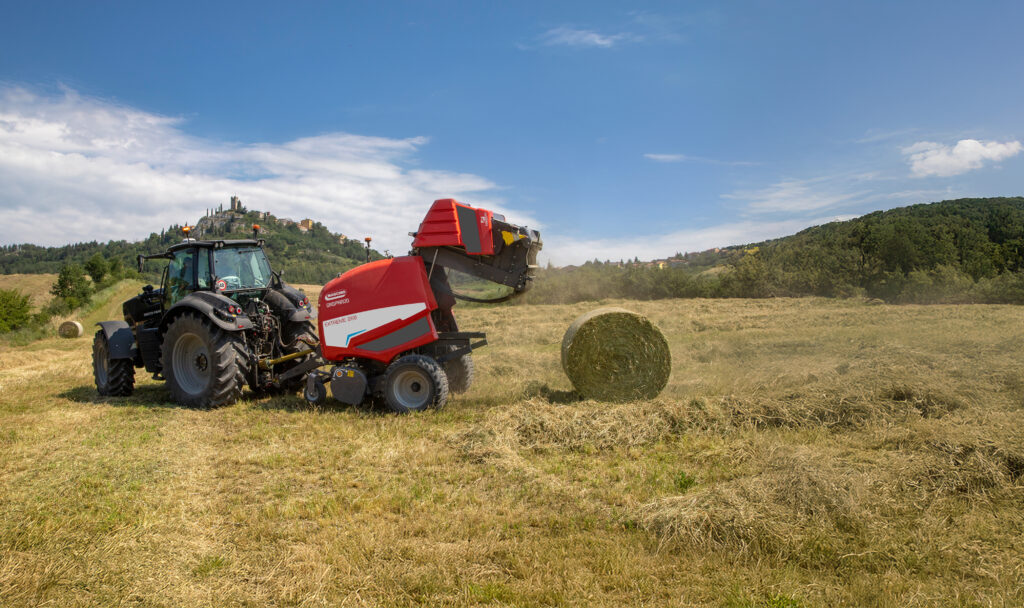
The Extreme round baler detects the humidity of the hay during harvesting and automatically adjusts the pressure exerted by the belts on the round bale being formed (Maschio)
Parameters
The most commonly recorded parameters are those relating to the area in which the equipment operates; they aim to determine the position of the machine or, more precisely, its tools, in relation to the ground, the crop, or both. This information serves a different purpose from that provided by GNSS or RTK georeferencing. The former aim to guide the implement in its work, as is the case with weed control equipment, whilst the latter locate the machine’s position within the Earth’s geodetic system. Integrating these two sources of information (if recorded) allows the data collected or actions carried out to be plotted on georeferenced maps, thereby providing the basis for the creation of a prescription map, the foundation of precision farming.
The parameters measured may relate solely to the geometry and dimensions of the crop, as is the case with vineyards or certain arable crops. The dimensions of the crop or a part of it can provide information on the phytosanitary status or make yield forecasts, for example in the case of lettuce heads, or in other crops. For example, this type of measurement, combined with leaf density measurements, is implemented on machinery that carries out treatments not only on vines and tree crops but also on herbaceous crops. Knowing the volume and density of the plant allows for the correct orientation of the product flow and the adjustment of the flow rate to the nozzles or, in any case, the intensity of the treatment.
The data to be collected may, on the other hand, be of an agronomic nature and relate, for example, to the analysis of existing vegetation and the distinction between cultivated crops and wild vegetation, the condition of the soil and in particular its moisture content, the presence and phytosanitary condition or stage of ripeness of a crop, a plant or its fruit, and other factors. Technological evolution now makes it possible to detect even such complex elements and process them to determine the most appropriate action for the task the machine is performing in the field. This is the most advanced sector of automation because, whilst the physical action carried out may be relatively simple, the decision on whether to implement it or not involves highly complex considerations, as it requires the recognition of elements with high variability in the environment. Furthermore, the time between detection and the implementation of the response is in the order of hundredths of a second, which presupposes that the processing is ultra-fast and that the mechanical apparatus is capable of moving rapidly and can do so without disrupting the crop.
Other data collected by agricultural machinery may be self-referential; this refers to the operation of the machine itself, and are intended to verify compliance with the settings implemented by the operator and, if necessary, intervene to optimize the process. Typical examples involve components that help ensure compliance with sowing or transplanting density, or the dose of solid or liquid product distributed in the field, or the quantity of feed loaded into the hopper of a chopping-mixing wagon. They can be extremely simple if the aim is simply to detect variations in the weight of the machine’s tank or hopper, or conversely of considerable complexity if the aim is to detect the passage of the seed, or the quantity of product distributed in real time. In this particular field of mechatronics, it is important to note how the development of electronics, information technology, and highly precise and responsive electrical systems for operating actuators has enabled the evolution of seeders and transplanters that operate by electronically synchronising the kinematic chain that deposits the seed or seedling in the soil. These self-referencial control and synchronisation systems have made it possible to develop machines capable of operating on mulch films, thereby extending this cultivation technique to contexts where full mechanisation of the operation and operational efficiency are of paramount importance.
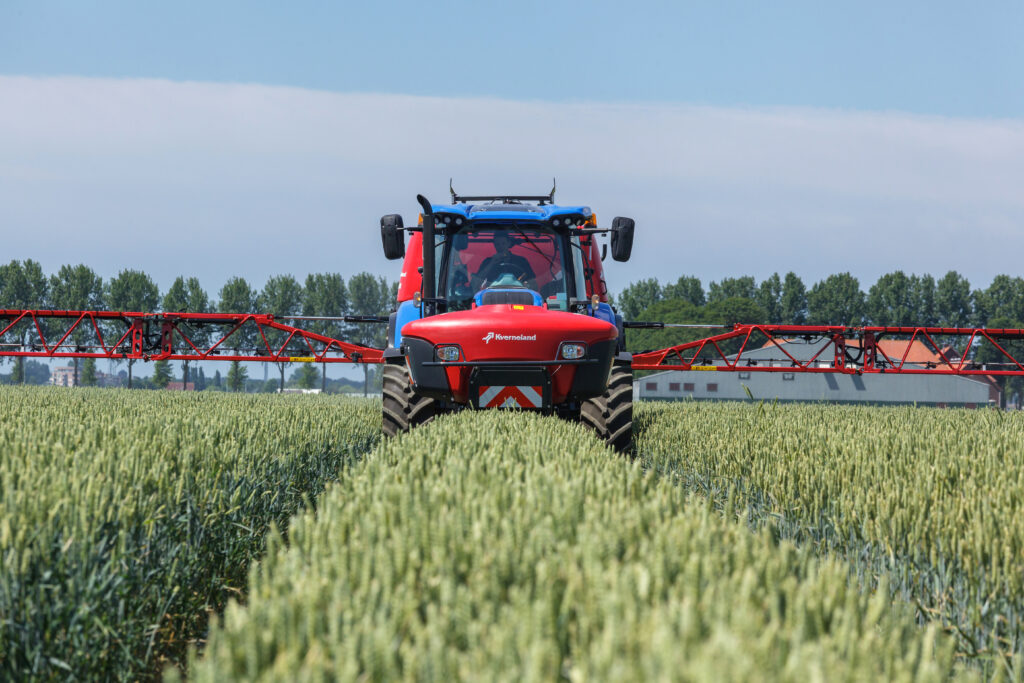
The SpotSpray system enables the sprayer to activate individual sections based on instructions provided by a prescription map, allowing only the necessary areas of the field to be treated. The arrangement of the nozzles, spaced just 25 cm apart, allows spraying to take place very close to the crop, thereby minimising drift (Kverneland)
Intelligent Automation
Automation becomes intelligent when the task at hand requires complex analysis that simple algorithms would be unable to process appropriately and within a timeframe compatible with the operation’s requirements. In such cases, the use of artificial intelligence (AI) software is essential. These systems only become operational after a phase during which they “learn” to recognise an element or develop a sequence based on uncodified information.
Let us suppose that it is necessary to recognise a lettuce plant so that the weeding machine does not damage it. Obviously, the “machine” will need to be able to recognise it at different stages of development and across different varieties, which, as is well known, are characterised by leaves of varying shapes and colours. For the machine to learn, it needs to be provided with hundreds of images of lettuce representing different stages of development, varieties and growing conditions. By repeating a process countless times (which we might call self-learning), the software learns to associate a series of attributes, properties and characteristics with the lettuce, which will then enable it to recognise the plant within an image taken in the field. The repeated process is known, but the conditions and attributes chosen to perform the task are not; these will vary depending on the input and the element we want it to recognise, be it a plant, a fruit, a diseased leaf, … Just as it is difficult for us to understand on what basis our brain recognises a plant, an animal or a person’s face, so it is not possible to know which features of an image cause the software to distinguish lettuce from a sneezeweed or a ragweed.
Artificial intelligence is therefore essential for processing complex information, such as that contained within an image. The earliest and still most widely used today applications involve recognising a face in an image (such as the facial recognition required to unlock a mobile phone), a bird or a plant. In agriculture, it is widely used to distinguish cultivated plants from weeds, vegetation from bare soil, and to assess the physiological state of a crop or the presence of plant diseases. Another rapidly developing field of AI involves the configuration of complex mechanical systems in response to changing operator input and the environmental conditions in which the machine operates. A typical example is the Internal Combustion Engine (ICE), which, as the name suggests, manages internal combustion engines with the aim of improving performance, reducing environmental impact and extending the engine’s service life. However, the dynamic adjustment of engine parameters useful to instantly adapt to operating conditions, thereby improving overall efficiency, is also based on AI software for electric vehicles, where it is integrated with effective battery management.
Today, this software is also used to extract simple information from the real world, such as the movement of seeds through the seed meter tube of a seed drill. This is because the evolution and diversification of the software has led to the widespread availability on the market of formats capable of performing numerous functions and applicable in a wide variety of contexts.
Agricultural machinery will therefore increasingly feature AI-controlled mechatronics; a future that could prove to be very positive.
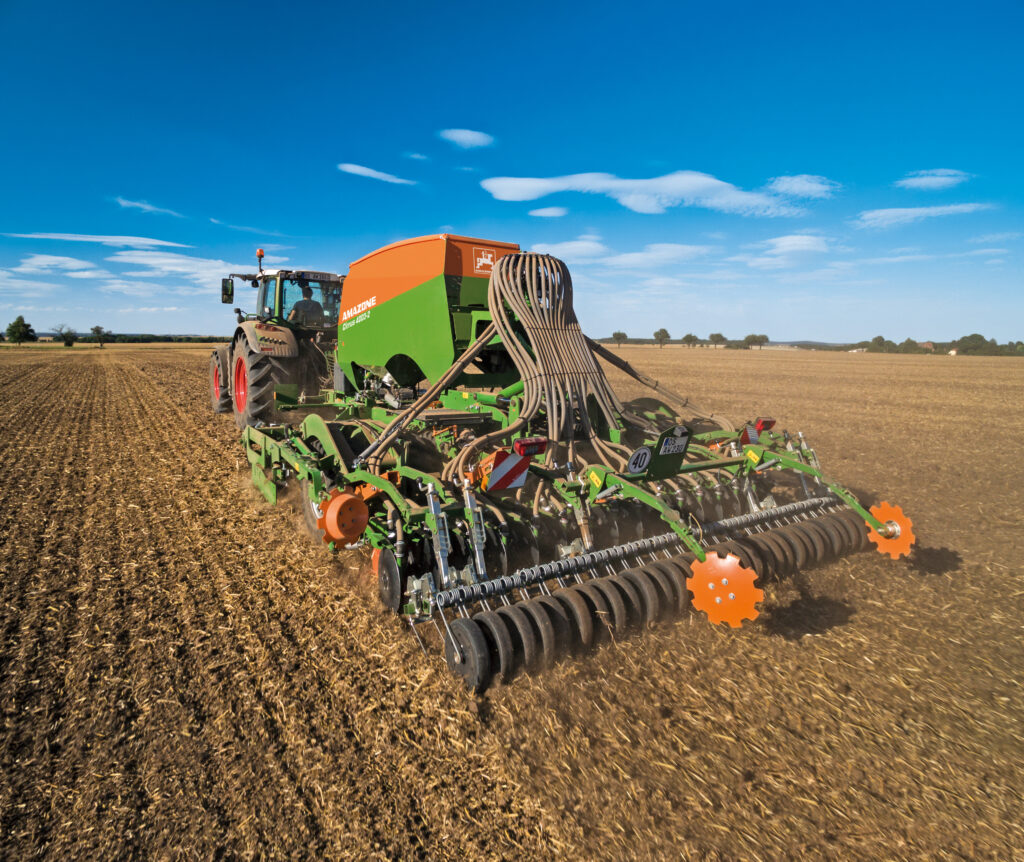
Cirrus can operate in accordance with the guidelines provided by seeding and fertilisation maps and soil characteristics, thanks to its built-in self-adjusting systems, which allow the user to adjust the amount of seed and fertiliser applied, as well as the pressure exerted on the disc coulter. Variable pressure settings ensure a constant sowing depth (Amazone)
Lorenzo Benvenuti