Among the sensors already in use and well-established on the market are, without a doubt, seed flow sensors, which have now become a standard feature in the designs of many manufacturers. However, they are not the only ones…
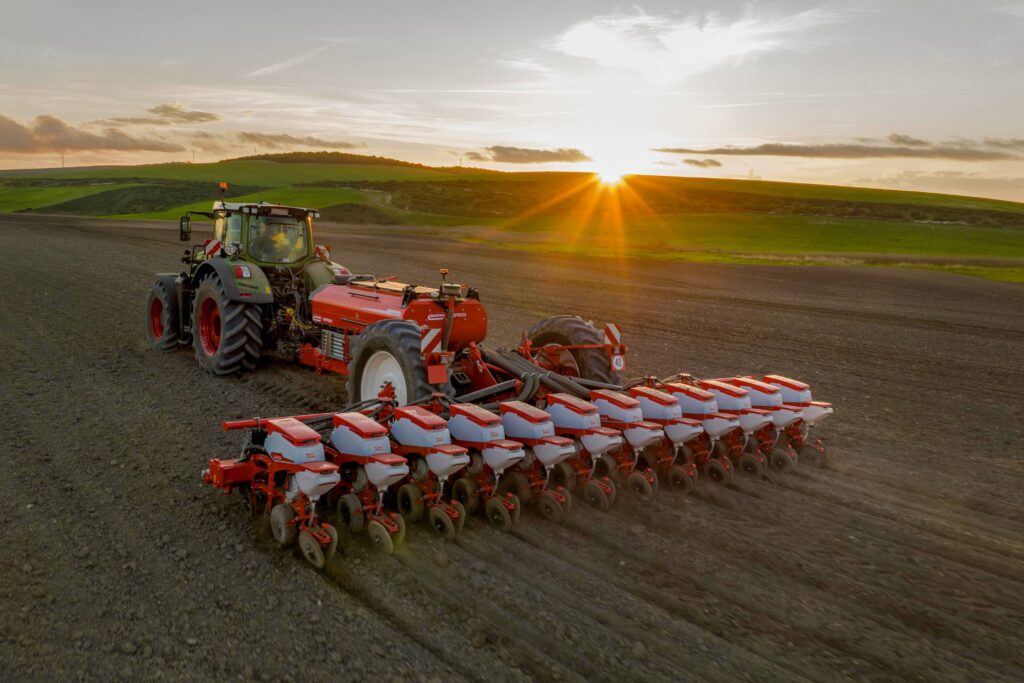
(Maschio Gaspardo)
Sowing is undoubtedly one of the most delicate and complex agricultural practices. The tight deadlines faced by farmers and contractors have led manufacturers to develop high-tech, high-performance machines that minimise failures, even in difficult soil conditions. You may have the best hybrid on the market in the seed drill’s hopper, but without a machine capable of placing it at the right depth, spacing and uniformity, the financial losses begin to mount up significantly right from the early stages of planting.
The technical resources and product ranges offered by the various manufacturers have reached extremely high levels of specialisation, whether we are talking about row-crop or precision seed drills; in the latter category in particular, the complexity and precision of the mechanical components and all the associated synchronisation mechanisms make this equipment a true showcase of engineering applied to the sector. Given the wide range of options available on the market today, it is worth providing an overview of the technologies currently in greatest demand and most popular, and which of the newer ones are gaining ground.
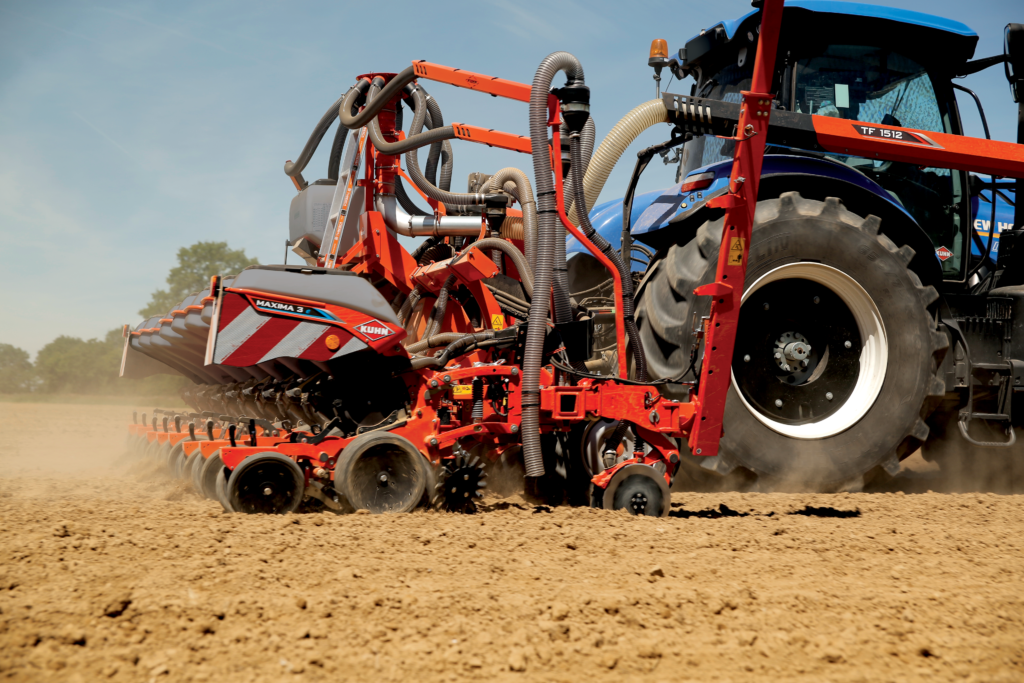
Sensors allow for the timely detection of machine failures and malfuncions (KUHN)
Seed Flow Sensors
Seed flow sensors have now become a standard feature in the design specifications of many manufacturers. These are almost always installed on the seed drop tube or immediately downstream of the seed distributor and, in single-seed drills, measure the passage of each individual seed and the rate at which it falls into the furrow. This makes it possible to count the seeds deposited and identify any omissions or double seedings. The sensors used are generally infrared sensors, and their operation is based on a beam of electromagnetic waves in the infrared spectrum that passes through the section of the tube where the sensor is located. The passage of the seed interrupts this infrared light beam, generating an electrical pulse that is transmitted directly to the implement’s PLC (Programmable Logic Controller), which interprets the signal as a ‘seed passing through’ and consequently the pulse is a positive feedback signal. If, on the other hand, no seed passes through and this infrared beam is not interrupted, the signal is not transmitted and an alert is displayed directly on the tractor’s in-cab control screen. Sometimes, certain manufacturers are able to indicate, via specific interactive interfaces on the on-board computer, which tube or part of the seed drill the alert originates from, so that an immediate and precise correction can be made without wasting time in the field. The positioning of the sensor on the machine is a critical aspect that affects the accuracy of the count and the potential sending of false pulses that can generate incorrect error alerts. Commercially available infrared sensors are classified into two types based on the infrared beam they operate in: single-beam infrared sensors and dual or multiple-beam sensors. The difference lies in the sensor’s level of accuracy, as the former are much coarser, while the multiple-beam ones are very accurate and can distinguish between seeds and impurities.
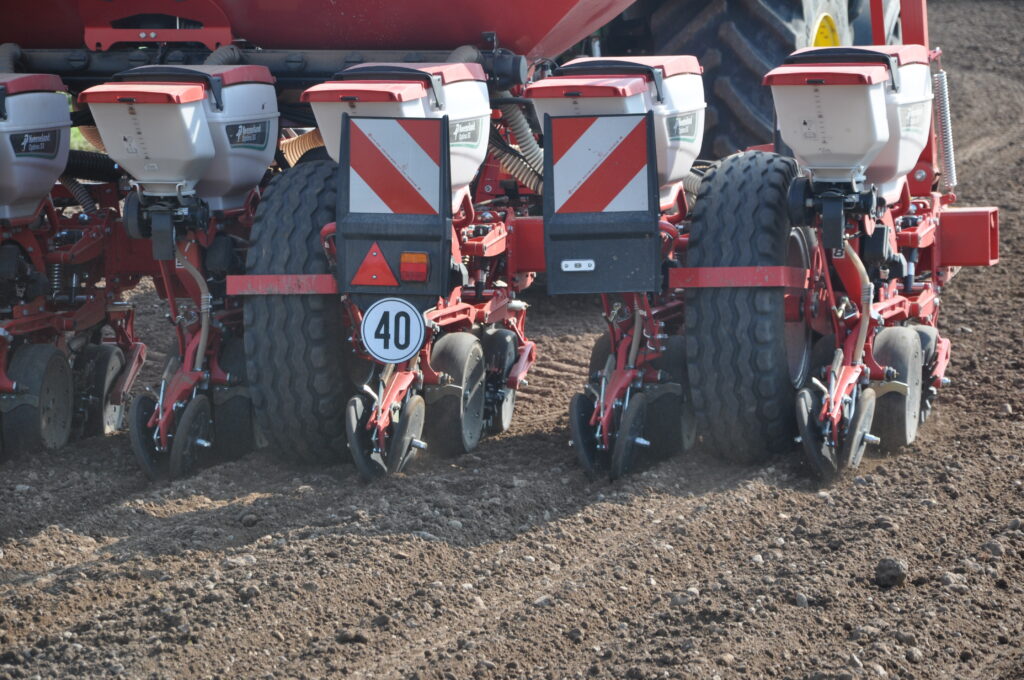
Controlling the pressure exerted on the ground by the sowing units is a key feature of modern seed drills (Kverneland)
Sensors to Monitor the Speed of the Seeding Disc
Another important sensor that has become widespread with the advent of electric seed drills and modern sowing techniques, which involve high-speed operation, is the seeding disc speed control sensor. These are encoders integrated into the electric drive motors, capable of measuring the rotational speed of the seed drill’s drive shaft and, indirectly, the number of revolutions of the seeding disc. The encoders continuously exchange signals with the electronic control unit (PLC): in the event of disc rotation anomalies, the system generates immediate warnings in the cab; at the same time, when the operator modifies the sowing parameters, as occurs in variable-rate applications, the electronic control automatically adjusts the disc rotational speed according to the new operational requirements. The disc’s tangential speed, the number of holes and the forward speed are the three parameters that determine the sowing distance along the row.
Sowing Depth
Sowing depth is one of the critical variables that determines uniform emergence. In modern seed drills, this parameter is no longer regulated by ‘traditional’ mechanical adjustments, but rather by sensors capable of adapting the seed placement depth according to soil conditions. The position of the seed in the furrow is detected indirectly, as the sensors measure the position of the coulter relative to the ground. This technology becomes highly attractive when combined with special systems for regulating the pressure of the sowing unit. This other group of sensors, on the other hand, is capable of detecting the pressure exerted on the ground by the seeding units and allows the pressure to be adjusted accordingly, based on the type of soil encountered during sowing. By combining the two technologies, the issue of soil variability can be effectively compensated for, even within the same plot. The future of this symbiosis of sensors is undoubtedly the integration with specific soil moisture detectors, so as to deposit the seed at a depth that allows the correct imbibition of the seed for rapid and efficient rooting.
Level and Flow Sensors
Another category that has long been established in the niche market for seed drills is that of product level and flow sensors. The former are mainly installed in seed and fertiliser hoppers and are mostly capacitive, meaning they are designed to signal the minimum product level. This simple piece of information is essential to avoid moving forward in the field without actually placing the seed in the soil, or to prevent loading quantities of seed into the tanks that exceed requirements and thus avoid stopping for checks.
The effectiveness of all these technologies lies in the synchronisation of data between the tractor and implement control systems, made possible by ISOBUS. Through the use of GPS systems and interpolated prescription maps, which, according to various parameters such as soil texture, soil moisture and nutrient content, allow for the tailoring of all sowing variables based on soil conditions. This allows for the maximisation of input use, particularly if, as is often the case, fertiliser is also applied during sowing. Among the wealth of information that maps can provide, we can obtain data on macro and micronutrient content; the tractor’s GPS reads its position in real time relative to the map loaded onto the on-board computer and sends instructions on how to ‘operate’ to the implement. For example, in areas where a high nutrient content is detected, the machine will distribute a smaller amount of fertiliser than in less fertile areas; this leads to very significant economic, agronomic and environmental benefits.
AI Interface
The latest developments in this field are moving towards the integration of AI (Artificial Intelligence) interfaces that assist farmers in calibrating and adjusting machinery based on the parameters detected by sensors during operation. Introducing a third element such as artificial intelligence into the complex yet well-established connection between machine and implement can further facilitate the work; however, as with any significant change, major implementation barriers may be encountered in the early stages. Nevertheless, the key to maximising the functionality of all these technical tools lies precisely in the synchronisation of the information that the sensors send to the machine and in their synergistic use. By installing AI technologies in on-board computers, these signals can be better organised and interpreted. Already today, many adjustments, thanks in part to the sensors, can be made comfortably and directly from the tractor cab, without those annoying ups and downs just to move a component a few centimetres.
A Solution for le Obsolete Tractors
One of the challenges facing Italian agriculture is undoubtedly the obsolescence of much of the machinery fleet, and for small and medium-sized farms it is difficult to invest in highly complex equipment such as a modern seed drill. To address this, many companies have specialised in producing sensor kits that can be fitted even to older machinery to bring it up to date technologically. Each of these sensors can be connected to an on-board computer, which can also be installed on older tractors that are not already equipped with a smart interface in the cab. This option significantly extends the useful life of machinery fleets, and small business owners can remain competitive without necessarily having to rely on a subcontractor.
During the short and delicate journey from the seeder hopper to the soil, numerous problems can arise. Sowing is, in fact, one of the most complex agronomic practices, and its success can only be guaranteed by these high-tech tools, which ensure that every single phase of the sowing process is carried out correctly.
PRO-SEEDER
PRO-SEEDER is a sensor developed by MC Elettronica, a leading Italian company specialising in the design and manufacture of high-tech electronic components for the agricultural sector. Specifically, the PRO-SEEDER is a counter photocell designed for pneumatic row seed drill, engineered to check the passage of seed or granular fertiliser through the drop tubes. The sensor enables precise counting of the material distributed, ensuring that the correct flow is verified on every single row. Thanks to its real-time monitoring function, the PRO-SEEDER photocell allows for the immediate detection of any sowing anomalies, such as missed distributions or interruptions in the flow, helping to increase operational efficiency and the precision of agronomic operations.
Alessandro Fioriti