Six use cases, six countries, five years of work: the European AGROBOOST project is putting robotics and artificial intelligence to the test directly in the field, where robustness, safety and integration with existing machinery are key.
In the debate on autonomous agricultural machinery, the risk is always the same: stopping at spectacular demonstrations. A tractor operating without a driver, a robot that recognises a plant, an arm that picks fruit. But between the prototype and daily work lies a complex landscape of vibrations, dust, variable light, uneven terrain and operators moving around the work area. It is in this landscape that the real game of innovation is played.
This is the context for AGROBOOST, a project funded under Horizon Europe (Grant Agreement 101182954), set to begin in November 2025 and run for five years. Coordinated by University College Dublin, the programme involves an international network of partners with the stated goal of bringing robotics, artificial intelligence, automation and augmented reality out of the laboratory and into real agricultural worksites.
The total budget exceeds €5 million, almost entirely funded by the EU. But beyond the figure itself, what makes AGROBOOST particularly interesting for the agricultural machinery sector is its approach: rather than a single flagship demonstration project, it comprises six operational validation campaigns across six European countries, each focused on a specific use case.
Six Applications, Six Test Benches
The applications selected are not chosen at random. They cover a range of production contexts that vary in terms of environmental complexity, the degree to which the workspace is structured, and operational criticality.
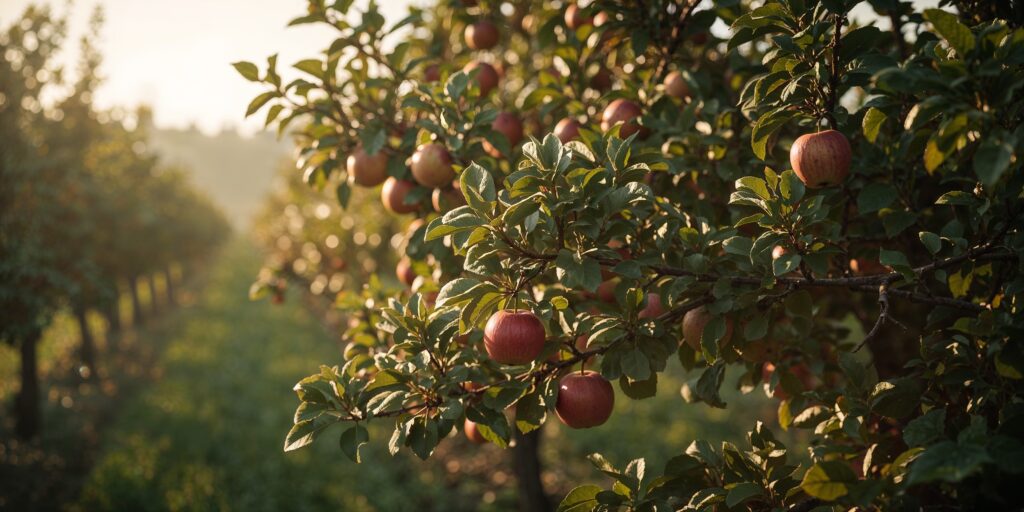
The first area concerns pruning and flower thinning in orchards. Here, the challenge lies not only in the visual recognition of the branch or flower, but in the combination of precision of movement, safety and operational speed. Automation must ensure a targeted, repeatable intervention that is compatible with the company schedule.

The second case concerns the selective harvesting of mushrooms, an environment that is more controlled than the open field but extremely sensitive in terms of the delicacy of the product. It is an interesting scenario because it allows autonomous systems to be tested in a semi-structured context, where human-machine interaction is close.
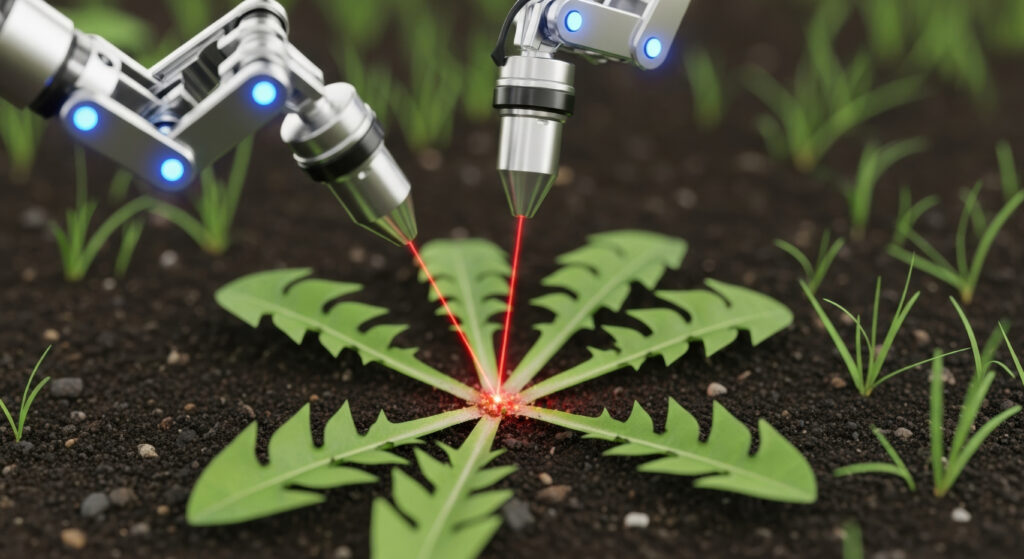
The third area is one of the most relevant for the equipment sector: automatic selective mechanical weeding. This is where advanced computer vision and classification algorithms come into play to distinguish between crops and weeds. Above all, however, it measures the machine’s ability to operate in real field conditions, with variations in light, soil, humidity and the presence of plant residues. It is in this type of application that the technological maturity of sensors, actuators and control systems is tested.

The fourth case study focuses on the delicate harvesting of strawberries. Precise handling, reduction of damage to the product, and maintainance of operational efficiency: these factors put kinematics, materials and gripping algorithms to the test. For machine manufacturers, it also serves as a test bed for reliability and maintenance.
The fifth area shifts to animal husbandry, with robotic systems for management and monitoring. Here, automation is intertwined with sensor technology and data analysis, raising the issue of integration between machines, software and farm management.
Finally, one of the most complex scenarios: monitoring and mechanical operations in viticulture on steep slopes. Here, stability, safety, the ability to adapt to the terrain and interaction with under-row equipment come into play. It is a scenario that also directly concerns manufacturers of specialised vineyard machinery.
Not just Robots: Models and Integration
One aspect that is often overlooked when discussing agricultural robotics concerns the integration of these solutions into existing machinery. AGROBOOST has made it clear that it also intends to work on business models and decision-making tools to encourage adoption. Put in technical terms: it is not enough to demonstrate that a machine works; it must be demonstrated that it integrates.
This means interoperability with ISOBUS systems and data management platforms, compatibility with equipment already on the farm, maintenance management and operator training. It also means addressing the issue of functional safety: obstacle detection, emergency stop, redundancy of critical systems.
From a design perspective, the real challenge is not the individual smart function, but the overall robustness of the system. Sensors that operate in dust and rain, control units protected against vibrations, actuators capable of maintaining precision over time. This is where research meets industrial engineering.
Selective, not Generalized Autonomy
AGROBOOST’s approach suggests a clear direction: autonomy does not mean completely replacing the operator, but rather automating repetitive, labour-intensive tasks or those that are difficult to perform safely.
Pruning, targeted weed control, delicate harvesting, and monitoring on slopes: these are activities where the added value of automation is measurable in terms of precision, reduced fatigue and operational continuity. It is likely that adoption will occur in functional segments rather than through fully autonomous multi-task machines.
For the agricultural machinery sector, this means rethinking electronic architectures, control systems, human-machine interfaces and, ultimately, software update models and technical support.
From Demonstration to Series
The project runs until 2030. Five years is sufficient time to move from demonstration to operational validation, but not necessarily to full-scale industrialisation. However, the fact that the tests are to be carried out in real farms, in actual production settings and across different countries, increases the likelihood that the results will be transferable.
For manufacturers and the components supply chain — from sensor producers to actuator suppliers, from vision systems to electronic controllers — AGROBOOST represents a privileged vantage point for identifying which technical solutions truly stand the test of time.
Ultimately, the value of the project lies not in the promise of a ‘driverless tractor’, but in the gradual construction of a robust and integrated agricultural automation ecosystem. If robotics is to become a permanent fixture on farms, it will be through this kind of approach: less spectacle, more technical validation. And above all, greater attention to what happens when the machine leaves the laboratory and faces the reality of the field.
AGROBOOST — Project Details
Program: Horizon Europe
Grant Agreement: 101182954
Duration: Nov. 2025 – Oct. 2030 (5 years)
Coordinator: University College Dublin (Ireland)
Total Budget: € 5,0 millions
UE Contribution: € 4,99 millions
Pilot Countries: Portugal, Ireland, Greece, The United Kingdom, Belgium, Switzerland
Technical Focus: agricultural robotics, AI, autonomous weed control, selective harvesting, viticulture on slopes, automation in livestock farming.
Further Information: https://agro-boost.eu/
Caterina Tressilian